


Savings
Everyday savings made simple, along with money market and health savings accounts for specific needs.


Earn interest and checking account bonus rewards.
Get perks plus no monthly minimum and low fees.
Keep it simple with this low-cost checking account.
Build your balance with no overdraft fees holding you back.
Find the checking account that fits your life.
Enjoy the added benefits of a top-tier account.

Everyday savings made simple, along with money market and health savings accounts for specific needs.
Open our basic savings account if you want low (or no) fees.
Give family members under 18 a savings account head start.
Step up your savings with a high-yield money market account.
Got a high-deductible health plan? You're eligible for an HSA.


Explore options to reduce your mortgage rate or monthly payments and consolidate credit card debt, or fund other financial goals.
Buy a new car, truck, or SUV, or refinance an auto loan.
Finance your adventures on open waters or the open road.
Get behind the wheel of your dream RV at a great rate.
Reduce your rate and increase your borrowing power.
Get the rate and flexible terms. No collateral needed.
Build or rebuild your credit history and your credit score.


Manage your finances whenever, wherever.
Go paperless. Cut clutter and enhance security.
Go cashless with our safe, convenient virtual wallet.
Check your credit score and protect your credit.
Send and receive money the fast, safe, and easy way.
Send and receive wire transfers safely and securely.

Cash management tools, plus credits to offset fees.
Easy interest and operating expense management.
For small to mid-size businesses with low volumes.
Find the account that helps grow your business.
The documents you'll need for your type of business.


Prevent check and ACH fraud from spoiling a good day. Access ACH Debit & Credit Positive Pay via digital banking to help combat fraud.

Owner-occupied or investment, fixed or variable rates.
Flexible terms with fixed or variable rates.
Flexible terms with amortizations coordinated to the equipment's useful life.
Provides working capital for growing businesses.
Longer terms and low fixed rates for Missouri-based businesses.
Long-term, fixed-asset loans for land, building, and/or equipment.
Experts to help customize your loan for your unique needs.

Finance your commercial real estate project with the people's choice for "best commercial bank" and "best bank."
Prevent check and ACH fraud from spoiling a good day. Access ACH Debit & Credit Positive Pay via digital banking to help combat fraud.
Finance your commercial real estate project with the people's choice for "best commercial bank" and "best bank."
Finance your commercial real estate project with the people's choice for "best commercial bank" and "best bank."
Explore options to reduce your mortgage rate or monthly payments and consolidate credit card debt, or fund other financial goals.

Prevent check and ACH fraud from spoiling a good day. Access ACH Debit & Credit Positive Pay via digital banking to help combat fraud.
Everyday savings made simple, along with money market and health savings accounts for specific needs.
Finance your commercial real estate project with the people's choice for "best commercial bank" and "best bank."
Checking with perks or just the basics.
Everyday savings made simple, along with money market and health savings accounts for specific needs.
Put your financial wellness first with options from basic to health savings accounts.
Invest in your future with a safe, secure CD or IRA. Lock it in and let it grow.
Explore options to reduce your mortgage rate or monthly payments and consolidate credit card debt, or fund other financial goals.
Auto loans to credit builder loans–borrow with confidence from your local bank.
Rewards, cash back, cash-secured—find what you want in a credit card right here.
Grab cash or pay with a swipe or tap from your checking or savings account.
Bank online or on the go—free e-statements and digital wallet included.
Partner with a local bank that's invested in a lifetime of financial wellness.
Power save with our limited-time money market and CD special offers.
Low fees and minimums, high degrees of automated banking.
Make your funds work harder to meet your short-term needs.
Prevent check and ACH fraud from spoiling a good day. Access ACH Debit & Credit Positive Pay via digital banking to help combat fraud.
Cash back, rewards—and more of what you want in a business credit card.
Grab cash or cover everyday expenses, everywhere Visa® is accepted.
Experience the latest point-of-sale system with Clover from Fiserv.
Start-up funds, working capital or financing for expansion, serviced in house.
Finance your commercial real estate project with the people's choice for "best commercial bank" and "best bank."
Bank anywhere—all the essential money management tools included.
Partner with a local bank that's invested in a lifetime of financial wellness.
Prevent check and ACH fraud from spoiling a good day. Access ACH Debit & Credit Positive Pay via digital banking to help combat fraud.
Power save with our limited-time money market and CD special offers.
Finance your commercial real estate project with the people's choice for "best commercial bank" and "best bank."
Partner with our expert business lenders for a personalized experience.
Finance your commercial real estate project with the people's choice for "best commercial bank" and "best bank."
Home loans serviced in-house with the one-on-one attention you deserve.
Explore options to reduce your mortgage rate or monthly payments and consolidate credit card debt, or fund other financial goals.
Take an expert guide on your homeownership journey.
Calculators and an in-depth glossary to keep you informed.
Ready to make an offer? So are we. See what's new.
Find a banking or mortgage center near you.
Email, call, or pay us a visit. We'd love to see you.
Prevent check and ACH fraud from spoiling a good day. Access ACH Debit & Credit Positive Pay via digital banking to help combat fraud.
Take a trip down memory lane all the way back to 1867.
Everyday savings made simple, along with money market and health savings accounts for specific needs.
Learn about our commitment to community support.
Finance your commercial real estate project with the people's choice for "best commercial bank" and "best bank."
Pursue a career with purpose, possibility, and people who care.
Investing in a Certificate of Deposit (CD) could be your ticket to achieving financial growth without the uncertainty of other investments. So how do you secure the optimal CD rates that promise growth and stability? Investing in a CD with First State Bank can provide you with a reliable and profitable savings option ensuring that you receive a competitive rate and exceptional service tailored to your financial needs.
Whether you’re just starting to explore CD options or a seasoned saver, this guide will light up the path to unlocking the best CD rates, aligning your financial goals, and maximizing your returns.
Initial Deposit
The amount of money you choose to open your CD is the only deposit required, as most CDs do not allow additional deposits.
Term
The term of a CD is expressed in months.
Interest Rate
The published interest rate for the CD. When calculating, enter the actual interest rate, not the annual percentage yield (APY). It is important to remember that these scenarios are hypothetical and that future interest rates can’t be predicted with certainty.
Compounding
The interest earned on your CD is added to your CD balance at regular intervals. This is called “compounding.” A compounding calculator allows you to choose the frequency that your CD’s interest income is compounded. The more frequently this occurs, the sooner your accumulated interest income will generate additional interest. You may wish to check with your financial institution or account opening documents to find out how often interest is being compounded on your CD.
Annual Percentage Yield (APY)
The APY is the effective annual interest rate earned for this CD. A CD’s APY depends on the compounding frequency and interest rate. Since APY measures your actual interest earned per year, you can use it to compare CDs that have different interest rates and compounding frequencies.
Early Withdrawal Penalties
A fee could be charged if you withdraw your money before the CD matures. So before closing your CD account early, check with your financial institution about potential fees.
Certificates of Deposit frequently offer higher interest rates than traditional savings accounts, making them an excellent option for individuals looking to lock in a fixed rate over a set term. Usually, higher rates come with longer-term commitments, so consider whether you can afford to have your funds tied up for that long. Additionally, the interest rate is directly tied to the terms of the CD. This allows you to predict your earnings with remarkable accuracy, provided you hold the CD until it matures.
CDs usually offer fixed rates, which means you’re guaranteed a specific return on your investment over the life of the CD. This predictability removes the guesswork, making it easier to plan your financial future.
Finding the right CD term is crucial to aligning your savings strategy with your financial goals. The length or term of a CD can range from a few months to several years, and each option has its own set of advantages and considerations.
Short-term CDs—typically lasting from three months to a year, offer the advantage of quicker access to your funds. These can be a smart choice if you anticipate needing access to your money in the near future. While the interest rates might not be as impressive as longer-term CDs, the flexibility they offer can be priceless.
Long-term CDs—those lasting from one year to five years or more usually come with higher interest rates. This makes them a lucrative option for those willing to lock away their funds for a longer set period. When choosing a term, think about your financial goals. Are you saving for a down payment on a home, a vacation, or perhaps retirement? Matching your CD term to these specific goals can amplify your savings.
However, CDs often come with penalties for early withdrawal. If you need your funds before the CD matures, a long-term CD might not be your best bet. Flexible terms cater to different saving preferences, so it’s imperative to weigh the pros and cons carefully before deciding.
When it comes to CD accounts, one size does not fit all. There are various types of CDs, each offering unique features tailored to different savings goals and preferences.
Traditional CDs are the most straightforward and reliable form of CD accounts. They come with a fixed interest rate and a set term, making them easy to understand and ideal for those who want a low-risk investment. However, if you have a substantial amount to deposit, Jumbo CDs might be more up your alley. These CDs require larger minimum deposits but offer significantly higher interest rates in return.
View our CD Specials Page or Interest Rate Page for more information on current rates and specials.

CD laddering is a savvy strategy that can help you maximize your CD investments by splitting your funds across multiple CDs with staggered maturity dates. This approach keeps part of your investment liquid while capturing changing interest rates over time.
The basic concept involves dividing your investment into equal parts and investing each part in CDs with different terms. For example, instead of putting $10,000 into a single five-year CD, you could put $2,000 into five CDs with terms ranging from one to five years. When the one-year CD matures, you can reinvest that money into a new five-year CD, continuing the cycle as each CD matures.
By staggering the maturities, a CD ladder ensures that a portion of your savings is accessible at regular intervals. This can be particularly useful if you need occasional access to your funds. Furthermore, it allows you to reinvest in new CDs at potentially higher interest rates, capturing better yields as market conditions fluctuate.
Laddering balances growth and flexibility, making it a wise choice for both conservative and savvy investors. It reduces the risk associated with locking all your funds into a single rate, offering a blend of liquidity, security, and enhanced returns.
Opening a CD account might seem straightforward, but there are some pro tips to ensure you make the most of your investment. Start by clearly identifying your financial goals. Are you saving for a short-term goal, like a vacation, or a long-term one, like retirement? Knowing your goals will help you select the right CD term and type.
Ask your questions. Understanding the terms and conditions can make opening a CD a less stressful transaction. Pay attention to details like the minimum deposit amount, early withdrawal penalties, and whether the interest compounds daily or monthly.
Gathering the necessary documents beforehand can speed up the account opening process. Typically, you’ll need identification, your Social Security number, and proof of address. Check with a First State Bank representative for any additional requirements.
Once your CD account is up and running, managing it effectively can further boost your financial rewards. Tracking maturity dates is crucial to ensuring you don’t miss opportunities to reinvest or withdraw your funds as planned. First State Bank will send you a letter before your CD reaches full maturity, and you have 10 days after the CD terms expire to either renew your investment or close the account.
Reinvesting matured CDs can enhance compounded growth. When a CD matures, you can roll it over into a new CD, potentially taking advantage of higher interest rates. This creates a snowball effect, increasing your returns over time.
Choosing the right bank for your CD account can significantly impact your returns and overall banking experience.
Why Choose First State Bank for Your CD Account?
Need to know more? Contact a banking center manager.
Buying a home can be an exciting yet intimidating experience. However, you can make the home-buying process less stressful and speed up the closing process by securing a Pre-Approval Assurance. It’s a smart move for any prospective homebuyer. At First State Bank Mortgage, we offer a robust Pre-Approval Assurance program to streamline your home-buying journey and provide clarity, confidence, and convenience.
Pre-Approval Assurance from First State Bank Mortgage is more than just a preliminary estimate. It is a formal promise indicating how much we are prepared to lend you for your new home. This assurance gives you a significant advantage in the competitive housing market.
With Pre-Approval Assurance, you gain a clear understanding of your budget. This knowledge allows you to focus your home search within your financial means, ensuring you look at homes that you can realistically afford.
A pre-approval demonstrates to sellers that you are a serious and qualified buyer. This advantage can give you a stronger position during negotiations, making sellers more likely to accept your offer over others who may not have pre-approval.
Because your credit and financial information have already been reviewed, the loan approval process can be expedited. This efficiency can lead to a smoother and quicker closing process, allowing you to move into your new home faster.
Having a pre-approval in hand removes much of the uncertainty and stress associated with buying a home. You’ll have a clearer understanding of your financial situation and the home-buying process, making the journey more enjoyable and less stressful.
We are dedicated to providing personalized service and exceptional support throughout your home loan journey. We are here to answer any questions and address any concerns you may have, ensuring you feel confident and informed every step of the way.
Don’t wait until you find your dream home to start the mortgage process. Get pre-approved today! For more information or to start your pre-approval process contact us.
According to the Federal Trade Commission, consumers reportedly lost 8.8 billion dollars collectively to scams and fraud in 2022 . All forms of communication including emails, text messages, voice calls, and letters can be methods scammers use to trick people. While this can be overwhelming, there are a few easy things you can do to protect yourself.
Common Scamming Methods
| Method | Tips to Avoid |
|---|---|
| Emails | Fraudsters will send legitimate-looking emails to trick you into calling, visiting a fake website, or downloading malware. Never click a link or download an attachment from someone you don’t know. |
| Phone Calls | Scammers will try to pressure you into sending money or revealing personal information. Be wary of unexpected phone calls or texts. |
| Checks | Someone may ask you to cash a check as a favor. Never cash a check for someone you don’t know. |
| Online Payments | Someone may ask you to pay debts with cryptocurrency, gift cards, or prepaid debit cards. It’s safe to assume that it’s fraud. |
| Cash Transfers | Review online banking accounts like CashApp, PayPal, or Zelle® on a regular basis. Report transactions you don’t recognize immediately. Scammers may skim a few cents to test the account before taking a large sum of money. |
In the wake of the Silicon Valley Bank collapse, our staff has received many questions regarding the security of their funds. It is through these conversations that we understand the urgency of educating our customers and fellow community members on the ways you can protect your funds with Federal Deposit Insurance Corporation (FDIC) insurance.
As CEO & President of First State Bank, I am aware of the importance of regulations that promote fairness and protect consumers. Additionally, I serve as Chair of the Federal Reserve Bank of St. Louis’s Community Depository Institutions Advisory Council (CDIAC) and am the former Chair of the American Bankers Association (ABA) Community Bankers Council and a member of the ABA Board of Directors. In these roles, I focus on communicating the impact of policy decisions on the people we serve and providing input on ways to ensure the safety and stability in the banking industry.
First State Bank agrees with Secretary of the Treasury Janet L. Yellen, Federal Reserve Board Chair Jerome H. Powell, and FDIC Chairman Martin J. Gruenberg, “The U.S. banking system remains resilient and on a solid foundation, in large part due to reforms that were made after the financial crisis that ensured better safeguards for the banking industry.” We understand concerns regarding the impact of this bank failure on the entire banking industry and hope that our cosign can calm those worries.
One of the most common questions our team has received is “What is FDIC insurance and am I covered?” Here’s the answer: The FDIC insures up to $250,000 in a deposit account if the unlikely event of bank failure were to occur. You do not have to purchase this insurance, just by opening a deposit account with First State Bank of St. Charles or another FDIC-insured bank, you are automatically covered.

For the average person, the $250,000 standard insurance amount is more than sufficient. However, there are many people who require additional coverage. It is important to note that the $250,000 figure is per depositor, per insured bank, and for each account ownership category. Increasing your FDIC insurance is possible when you add a spouse to a deposit account, set up trusts with multiple beneficiaries, or establish multiple account types.
You may think that splitting your funds across several institutions will keep you covered, but that isn’t necessary. First State Bank, like thousands of other financial institutions, is a member of the IntraFi® network.1 This network allows customers to bank with us even if they have accounts that exceed the $250,000 standard insurance amount. Funds are conveniently and securely2 put into demand deposit accounts, money market deposit accounts, or CDs based on the specific needs of account holders.
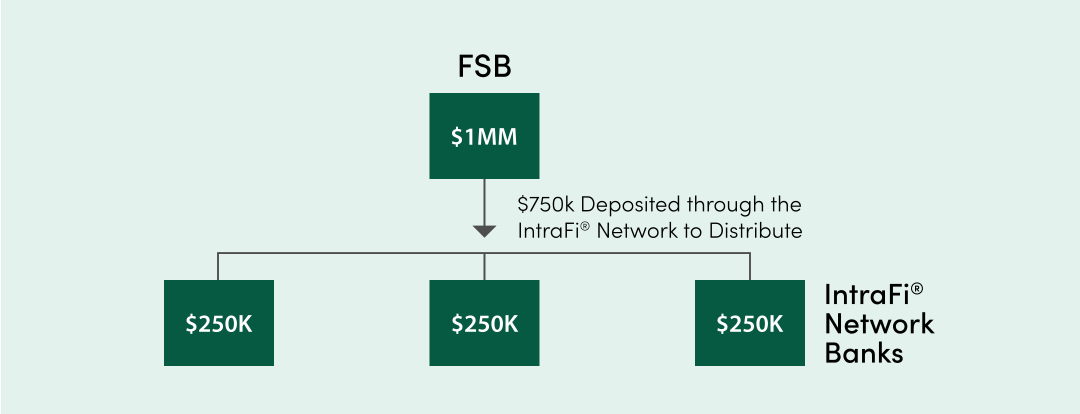
IntraFi® is a great option for businesses carrying high balances that may not be eligible for standard FDIC insurance. Contact one of our business experts to find out how we can help.
Lastly, we truly value the rapport we have with each of our customers. We have had so many optimistic conversations in the last few weeks and appreciate the opportunity to share our expertise to alleviate concerns. To see how the insurance rules and limits apply specifically to your accounts, I recommend using the FDIC’s free electronic deposit insurance estimator tool. If you need assistance using this tool, have questions or concerns regarding FDIC insurance, or would like to open or modify an account, please schedule an appointment with a First State Bank banking center manager or contact our Customer Care team at 636-940-5555.
Have an account elsewhere? Check to see if your money is insured .
Check here to see if a specific account type is FDIC-insured.
Read more on actions the U.S. Department of the Treasury, Federal Reserve, and FDIC are taking to protect the U.S. economy and depositors at Silicon Valley Bank and Signature Bank.
Summary of FDIC Deposit Insurance Coverage Limits
| Account Type | Limit |
|---|---|
| Single accounts (owned by one person) | $250,000 per owner |
| Joint accounts (owned by two or more persons) | $250,000 per co-owner |
| Certain retirement accounts (includes IRAs) | $250,000 per owner |
| Revocable trust accounts | $250,000 per owner per unique beneficiary |
| Corporation, partnership and unincorporated association accounts | $250,000 per corporation, partnership or unincorporated association |
| Irrevocable trust accounts | $250,000 for the noncontingent interest of each unique beneficiary |
| Employee benefit plan accounts | $250,000 for the noncontingent interest of each plan participant |
| Government accounts | $250,000 per official custodian (more coverage available subject to specific conditions) |
1 Full list of participating financial institutions in the IntraFi® network.
Often, borrowers will use their current bank or choose a lender based on a recommendation when buying a home, but it’s important to shop around when you are looking for a home loan because not all lenders offer the same rates.
When comparing mortgage interest rates, it helps to understand how they are determined in order to get the best rate possible. There are some personal factors you can control and other external factors that you cannot control which help lenders set their rates.
Personal factors are reviewed to determine your risk level. If your circumstances offer less risk for the lender, you should receive a more favorable interest rate.
External factors have a big impact on mortgage rates. They can cause mortgage rates to move up and down daily, sometimes multiple times in one day, based on current and expected economic indications.
Mortgage Rates Based on Stock Market Performance
| Mortgage Interest Rates | Inflation | Employment Rates | Stock Market Performance |
|---|---|---|---|
| Rates Decrease | Low | High | Low |
| Rates Increase | High | Low | High |
While some of these factors are out of your control, you can control the personal factors mentioned above. To get the best possible interest rate watch your credit score, lower your debt-to-income, save up to make a higher down payment and reduce your loan-to-value ratio, and choose the right mortgage lender.
If you have any questions, please contact a First State Bank Mortgage loan officer today.
You’ve probably seen or heard ads for a “no cost refinance” loan, but what does that really mean? How do these loans work?
These ads promise the homeowner no fees or out-of-pocket expenses when refinancing their current mortgage. But the lender must make money somehow, so they increase the interest rate or add the fee costs to the loan amount to compensate for the missing fee income.
The tradeoff is that the borrower pays nothing now, but they will end up paying more over the life of the loan in the form of higher monthly mortgage payments and more interest over the term of the loan.
For some borrowers, a no-cost loan may be the better option if they don’t have the funds available to pay fees at closing. If you have enough money to pay closing costs, then you need to decide if you would prefer to hold onto your money or get the lowest possible interest rate.
Pay Attention to the Details.
Be sure to read the fine print of your “No Cost Refinance.” These programs can vary by lender. Some may only cover lender fees such as origination, underwriting, and processing fees, while others may include third-party costs like title and appraisal expenses. Pay attention to what fees are covered to determine if it’s a good or bad deal.
The benefits and costs of a “No Cost Refinance” depend on each borrower’s unique financial situation, what the associated fees are, and what the interest rate will be.
Although you may avoid out-of-pocket expenses upfront, these costs are not paid by the lender and are not a true no-cost loan. Be sure to do the math and compare your options before you make your final decision.
If you have any questions, please contact a First State Bank Mortgage loan officer today.
The First State Bank team wants to empower our customers to take control of their financial health. We understand our customers need easy-to-use, free credit reporting tools to help establish or rebuild their credit score. So, we partnered with SavvyMoney® and TransUnion® to launch the My Credit Score tool exclusively for our personal digital banking customers. These new benefits include:
Personal digital banking account holders can get started anytime. To enroll in this free service, simply login to our Digital Banking platform. To learn more, check out our My Credit Score webpage for enrollment steps and other frequently asked questions. Call 636.940.5555 to speak with a member of our team or schedule an in-person appointment.
If you have a college-bound student in your family, chances are you have your hands full with college applications, scholarship forms, student loan applications, and more. With so much going on, it’s understandable that your student’s banking needs may be an item on the back burner. We suggest researching your options now so you can be assured your college student’s banking needs are met before next semester begins.
At First State Bank we have a diverse line of checking and saving accounts that could be the right fit for your student. All our accounts include a suite of digital banking tools that allow customers to manage their finances from anywhere. This is perfect for busy students who have limited time between school and other commitments.
For families that are managing finances together, you have the option to open an account that both your student and you have equal access to. If that’s not the best option for your situation, you can also utilize Zelle® to quickly and safely send money from one account to another – regardless of where you bank.1 This allows you to directly assist your student along in their journey toward financial independence.
Having account benefits that make your life easier is essential. Fortunately, our community bank partners with BaZing to bring you incredible perks! By opening an account powered by BaZing you can save money on everyday essentials, school supplies, and more. BaZing also offers services that bring you peace of mind including cell phone protection,2,3 roadside assistance, and buyer’s protection and extended warranty.2,3
Most importantly, our bank offers unbeatable customer service! We know that managing finances for the first time can be overwhelming. First State Bank’s expert team members can guide parents and students in selecting the right account. Call us today at 636-940-5555 to talk through any questions you have or sit down with us in one of our banking centers. No appointment is necessary for one-on-one attention.

1 U.S. checking or savings account is required to use Zelle.® Transactions between enrolled users typically occur in minutes and generally do not incur transaction fees.
2 Subject to the terms and conditions detailed in the Guide to Benefits. Participating merchants on BaZing are not sponsors of the program, are subject to change without notice, may not be available in all regions, and may choose to limit deals.
3 Insurance products are: Not a deposit. Not FDIC-insured. Not insured by any federal government agency. Not guaranteed by the bank.
The Federal Reserve Bank of St. Louis has appointed four new members to its Community Depository Institutions Advisory Council (CDIAC), including president & CEO Luanne Cundiff. The council advises St. Louis Fed President James Bullard on credit, banking, and economic conditions facing local communities.
First State Bank prioritizes the financial health of the communities we serve. We are very excited that Cundiff’s new role will allow First State Bank to help positively influence the St. Louis economic landscape. Regarding her appointment, Luanne says, “I am honored to represent First State Bank by providing feedback to the Federal Reserve System on local banking and economic conditions.”